
Knowledge
AI Creatives for Meta & TikTok Ads: How Much the Machine Really Takes Over
How AI is changing creative production for paid social – what it can do today, where human judgement counts and how a workflow connects volume and quality.
By Roxana Lichtenstein Prefer us on Google
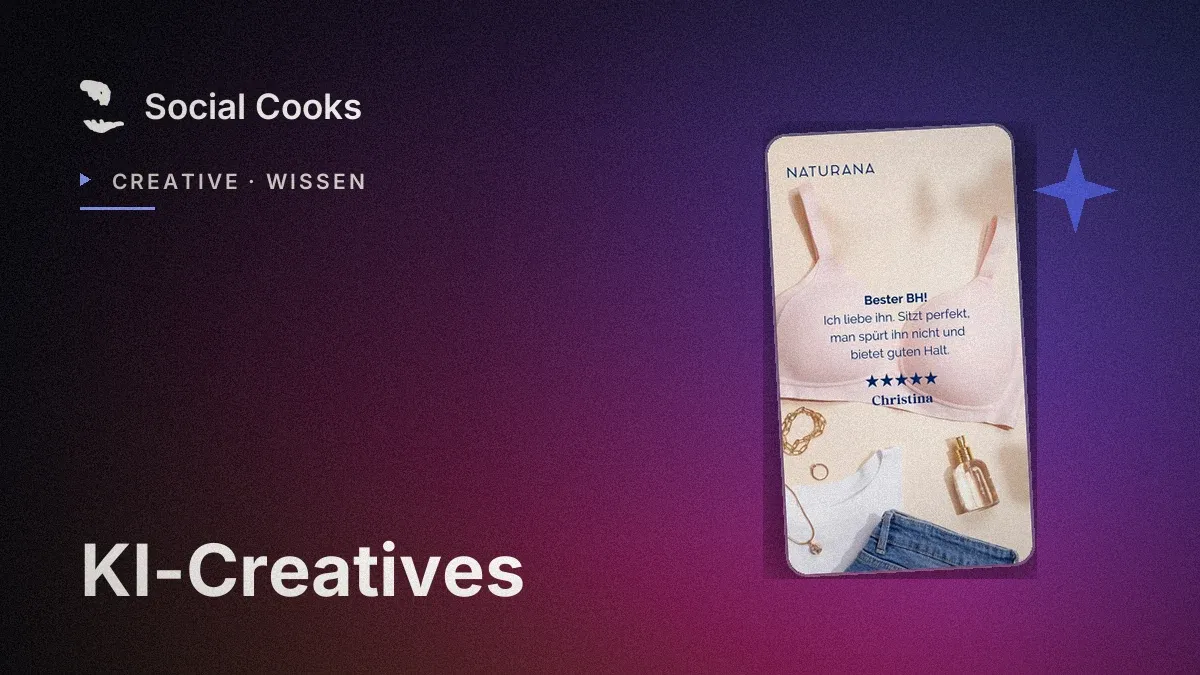
Hardly any topic is discussed as excitedly in performance marketing as AI in creative production. One camp expects ads to be created at the push of a button in future; the other considers AI creatives to be faceless junk. Both camps miss the decisive point. AI does not change what makes a good creative – but how fast and in what volume you get there. This guide sorts out what AI in ad production really achieves today, where humans remain indispensable and what a workflow looks like that connects the two.
Why the creative has become the targeting
To understand the value of AI creatives, you first have to understand why creatives have become so much more important in the first place. Delivery on Meta and TikTok is now largely automated: instead of manually narrowing tight audiences, you leave the steering to the system, and it finds the purchase-ready users itself. The basis of this decision are the signals your creative generates – who stops, who watches, who clicks, who buys.
This shifts the leverage. In the past the most important lever lay in the audience settings; today it lies in the motif. The creative has effectively become your targeting: which people see an ad is decided less by ticks in the ads manager than by the question of who the video or image speaks to. How this algorithmic delivery works and what it means for account structure, we go into in the article on Meta Andromeda and the interplay of creative and targeting.
This shift has an uncomfortable consequence: the need for fresh, varied creatives has risen massively. An account that wants to scale burns through motifs faster than a classic production process can supply them. This is exactly where AI moves from hype to a real tool – not as a replacement for creativity, but as an answer to a quantity problem.
What AI in creative production is really good at today
The most honest look at AI creatives starts with the tasks it reliably takes over. And these are above all the time-consuming, repetitive parts of production – those that slow a team down without requiring creative substance.
First comes variation. From a working motif, dozens of variations can be derived with AI in minutes: different hooks in the first seconds, new subtitle styles, adapted formats for feed, Reels and Story, swapped backgrounds or colour worlds. What used to cost an editor hours becomes a matter of minutes.
Second comes ideation. AI is a strong sparring partner for quickly formulating many angle hypotheses, writing hook lines or sketching script frameworks for UGC videos. Not every suggestion is good – but the sheer quantity of starting points accelerates the creative work considerably.
Third comes iteration. Once a winner is established, AI helps to systematically spin it further: the same core idea in new variants, so that a successful motif stays fresh longer. That is exactly the work that decides the lifespan of a creative – and which rarely happens consistently enough manually.
The common denominator: AI shines at volume and speed, not at the original creative spark. It lowers the cost per variant and fills the testing pipeline – two factors that directly pay into performance in today’s delivery model.
Where humans remain indispensable
Just as important as the strengths are the limits. Whoever hands AI the wrong tasks quickly produces a lot – but a lot that’s irrelevant. Three areas continue to belong to humans.
The first is strategy and the angle. The decision whether a creative runs via emotion, function or social proof, which customer problem it addresses and which message the brand conveys, is a strategic, not a generative task. AI can formulate angles but not judge which one really ignites for your audience. The human sets this hypothesis.
The second is brand voice and judgement. AI produces average very efficiently – and average is exactly the problem in the overcrowded feed. Whether a creative fits the brand, feels credible and doesn’t look like arbitrary stock aesthetics is decided by a trained eye. A human review step before launch is not a luxury but quality assurance.
The third is authenticity. The most effective content in paid social feels native, not like advertising. Real people, real voices, real usage situations – that is the domain of UGC and creator content. Purely AI-generated scenes can help out here, but rarely replace the credibility of a genuine creator. That’s why the most productive stance is not “AI instead of UGC” but “AI plus UGC”: authentic raw material, efficiently multiplied and iterated.
A workflow that connects volume and quality
The decisive question is not whether you use AI, but where in the process. A viable workflow assigns humans and machines to their strengths and lets the data decide in the end.
At the start stands the human hypothesis: which angles do we want to test, which customer problems do we address, what is the core message? No decision falls to the machine here.
This is followed by AI-supported production: from each angle many variants emerge – hooks, formats, cuts, text layers. Where authenticity counts, genuine UGC or creator material is added, which is then transferred into further variants via AI. This creates the necessary volume without triggering a new shoot for every idea.
Before launch the human review kicks in: does it fit the brand, does the hook carry, is the message clear? Whatever doesn’t pass this filter doesn’t go live.
And finally the testing decides. No matter how convincing a creative – whether from human or AI – it is at first no more than a hypothesis. Only the systematic test in the account shows what works. How to separate exploration and iteration, keep a weekly cadence and recognise creative fatigue early, our Creative Testing Framework for Meta Ads describes in detail. In this system AI delivers above all one thing: enough tested variants so that production never has to happen under pressure.
Terms like CPM, hook rate or creative fatigue, which keep coming up in this context, you’ll find explained compactly in our performance marketing glossary.
Conclusion
AI creatives are neither a miracle cure nor a threat – they are a tool that solves a real quantity problem. Since delivery has become AI-driven and the creative has taken over the role of targeting, you need more fresh, varied motifs than classic production can deliver. This is exactly where AI plays to its strength: volume, variants, iteration. What it does not replace is the human work on strategy, brand voice and authenticity – and the data-driven testing that turns hypotheses into winners. Whoever interlocks both cleanly produces not just more, but better. This connection of AI, craft and system is the core of our approach in Creative Engineering.